

Published on Nov 10th, 2026
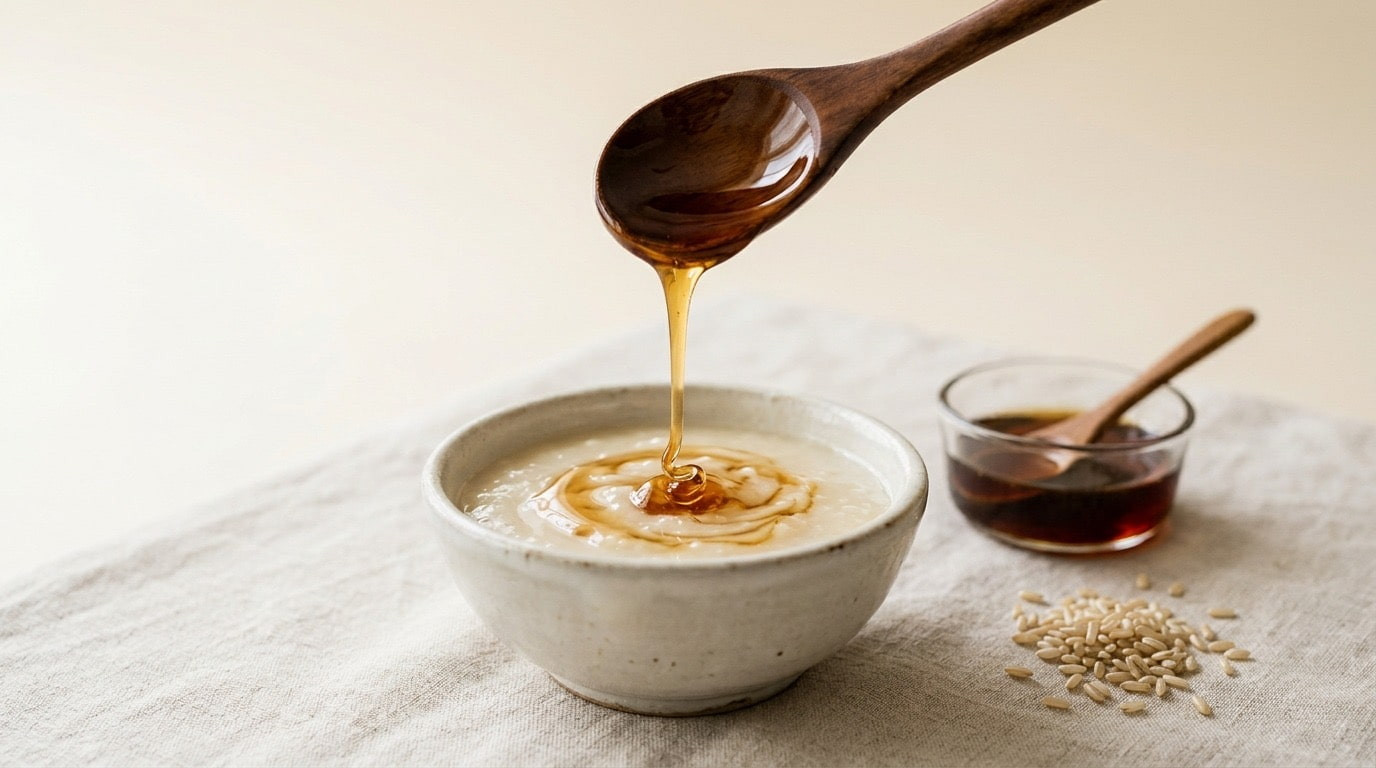
Developing food products for infants requires careful ingredient selection. Manufacturers must consider not only how an ingredient performs during processing but also its nutritional contribution, safety profile, and suitability for the intended age group.
Brown rice syrup is a rice-derived sweetener valued in food manufacturing for its mild flavor, viscosity, and binding properties. While these characteristics may be useful in certain formulations, using it in infant food requires a more detailed assessment. Nutritional considerations, inorganic arsenic levels, supplier quality, and applicable regulations all play an important role in determining whether an ingredient is appropriate for a specific product.
For food manufacturers, understanding these factors can help guide responsible ingredient selection and support consistent product quality.
Brown rice syrup is produced by breaking down rice starch with enzymes, converting complex carbohydrates into simpler sugars. The resulting syrup typically contains maltose and other carbohydrates, with its exact composition depending on the raw material and manufacturing process.
In food applications, brown rice syrup can contribute sweetness, moisture, and binding. Its relatively mild flavor may also be useful when a formulation requires sweetness without a strong additional flavor.
However, brown rice syrup is not nutritionally equivalent to whole brown rice. Processing changes the composition of the original grain, and the syrup primarily contributes carbohydrates and sugars rather than the full range of nutrients found in whole-grain rice.
This distinction is particularly important when developing products for infants, where nutritional composition must be evaluated in relation to the intended age group and product category. For further insights into its application in infant food formulations, read our guide on how to make ideal baby food using brown rice syrup.
Ingredient selection often depends on the desired texture, sweetness, processing behavior, and overall formulation goals. Brown rice syrup may offer several functional properties, although its suitability should always be assessed within the complete product.
Brown rice syrup provides sweetness that varies according to its sugar composition and concentration. Its relatively mild flavor may work well in formulations where manufacturers want to avoid a pronounced flavor from the sweetening ingredient.
However, sweetness should not be the primary consideration when developing infant food. Manufacturers need to evaluate the ingredient's nutritional contribution and consider relevant guidance on sugars in foods intended for infants and young children.
The syrup's consistency can help bind ingredients and influence the texture of certain food products. These properties may be useful in selected cereal-based applications and other formulations designed for appropriate age groups.
Product developers should assess how the syrup affects the final texture, particularly when the product is intended for infants at a specific developmental stage. Performance in conventional food applications does not automatically establish suitability for infant food.
Brown rice syrup can influence viscosity, moisture levels, and ingredient handling during production. Depending on the formulation, it may affect mixing, heating, and the consistency of the finished product.
Its performance depends on factors such as solids content, inclusion rate, and interactions with other ingredients. Application-specific trials can help manufacturers determine whether the syrup meets their processing requirements.
When evaluating brown rice syrup for infant food, ingredient functionality must be considered alongside safety and regulatory requirements. One important issue is inorganic arsenic, a contaminant that can occur in rice and rice-derived ingredients.
Rice can absorb inorganic arsenic from soil and water. As a result, rice-based ingredients, including brown rice syrup, may contain varying levels of this contaminant. Concentrations can depend on agricultural conditions, raw material sourcing, and processing.
Because infants and young children warrant particular attention when assessing dietary contaminant exposure, manufacturers should establish a documented approach to evaluating rice-derived ingredients.
Key steps include:
Reviewing analytical results: Request relevant contaminant testing data and determine whether additional independent testing is needed.
Setting acceptance criteria: Establish appropriate specifications based on the intended product and applicable market requirements.
Maintaining traceability: Keep records connecting ingredient batches to suppliers and finished-product lots.
Verifying supplier performance: Reassess ingredient quality when sourcing arrangements, specifications, or manufacturing processes change.
Manufacturers should not assume that processing eliminates inorganic arsenic. Ingredient approval should be supported by reliable testing and a risk-based assessment.
Requirements for infant formula, complementary foods, and foods intended for older children can differ significantly between product categories and markets.
Before incorporating brown rice syrup, manufacturers should confirm the product's regulatory classification and review applicable rules for ingredient use, contaminant limits, nutritional composition, and labeling. They should also consider current guidance on sugars in foods for infants and young children.
For products intended for multiple countries, these checks should cover each destination market. An ingredient that is acceptable in one food application or jurisdiction should not automatically be considered appropriate for another.
Manufacturers should confirm that ingredients meet appropriate microbiological specifications and that the production process includes suitable hygiene controls.
The finished product also needs to be assessed for shelf-life stability. Depending on the formulation, factors such as moisture content, water activity, packaging, and storage conditions can affect product quality and safety.
Testing should reflect the actual formulation and intended storage conditions rather than relying solely on the ingredient's specification.
An ingredient can provide useful functional properties without necessarily improving a product's nutritional profile. Brown rice syrup contributes carbohydrates and sugars, so manufacturers need to understand how it affects the overall composition of the finished food. To better understand its nutritional profile, sugar composition, and potential health implications, see this detailed overview of whether brown rice syrup is good or bad for your health.
During formulation, product developers should evaluate the syrup's contribution to sugar content and energy value, alongside the nutritional contribution of other ingredients. They should also determine whether the complete product meets the relevant nutritional objectives for its intended age group.
For infant formula, ingredient selection must follow the specific compositional and regulatory standards applicable to that category. Complementary foods also require careful consideration of nutritional suitability.
The key is to evaluate the ingredient according to its actual composition and intended purpose, rather than assuming that a rice-derived or plant-based sweetener is automatically a better nutritional choice.
A brown rice syrup substitute may be worth exploring when the original ingredient does not meet a formulation's functional requirements, nutritional objectives, sourcing needs, or regulatory criteria.
Before selecting an alternative, manufacturers should identify the specific property they want to achieve. For example, the priority may be sweetness, binding, viscosity, or compatibility with a particular processing method. Different ingredients offer different combinations of these properties.
When assessing a brown rice syrup substitute, manufacturers should compare:
Functional performance: How does the ingredient affect sweetness, viscosity, binding, and texture?
Nutritional composition: How does it change the finished product's sugar, carbohydrate, and energy content?
Safety considerations: What contaminants or other ingredient-specific risks require evaluation?
Processing compatibility: Does it perform consistently under the intended manufacturing conditions?
Regulatory suitability: Is it appropriate for the product category and destination market?
No substitute should be assumed to perform identically to brown rice syrup. Testing within the actual formulation is necessary to evaluate its effects on product quality and processing.
There are several potential alternatives for brown rice syrup, but the right choice depends on the intended application and the requirements of the finished product.
Other syrups may provide sweetness and binding properties, while alternative carbohydrate-based ingredients may be better suited to specific processing needs. However, differences in sugar composition, viscosity, and moisture contribution can affect how an ingredient performs.
When comparing alternatives for brown rice syrup, manufacturers should consider flavor, functional performance, nutritional impact, safety, and supply consistency. They should also review ingredient specifications and confirm that the selected option meets the applicable requirements for infant food.
An alternative that works well in a conventional bakery product, beverage, or snack may not be suitable for an infant food formulation. The intended age group and product classification must remain central to the decision.
Choosing a reliable supplier is an important part of ingredient evaluation. Manufacturers need clear information about product specifications, sourcing, and quality controls to make informed decisions.
When reviewing a brown rice syrup supplier, consider asking for:
Product specifications, including solids content and carbohydrate composition.
Current certificates of analysis and relevant contaminant testing results.
Information about inorganic arsenic monitoring and other applicable quality controls.
Batch identification and supply chain traceability documentation.
Details of quality management systems and procedures for managing changes to the ingredient or manufacturing process.
Manufacturers considering organic brown rice syrup should also verify relevant organic certification and confirm that the certification applies to the specific ingredient and intended market.
Organic status relates to production and sourcing standards; it does not automatically establish that an ingredient is free from contaminants or suitable for infant food. Appropriate safety testing and regulatory assessment remain necessary.
Brown rice syrup offers functional properties that may be useful in selected food formulations, including sweetness, binding, and moisture management. However, its use in infant food requires more than a review of its technical performance.
Manufacturers should evaluate its nutritional contribution, inorganic arsenic levels, regulatory suitability, and performance in the finished product. Where necessary, a brown rice syrup substitute or other alternatives for brown rice syrup may offer a better fit for the formulation's requirements.
Ultimately, the most suitable ingredient is one that meets the product's functional objectives while satisfying the relevant nutritional, quality, and safety criteria. A structured evaluation process helps manufacturers make decisions based on evidence rather than assumptions about an ingredient's origin.
At GluCorp, we work with food manufacturers and product developers to explore ingredient solutions that align with their formulation goals and quality requirements. Understanding an ingredient's functionality, specifications, and intended application is an important part of developing a consistent food product.
If you're evaluating rice-derived ingredients or exploring organic brown rice syrup for a food formulation, get in touch with GluCorp to discuss your ingredient sourcing needs and technical requirements. Our team can help you explore available options and identify the information needed to support your product development process.
BackBe the first to know about new products, events and offers.