

Published on Oct 26th, 2026
When food manufacturers choose an ingredient, they need to evaluate how that ingredient affects the formulation. They consider factors like how easily it dissolves, how evenly it disperses, how it flows through production equipment, and how it behaves during storage. These factors are so essential for choosing the right ingredient because they can all influence the final product.
Tapioca maltodextrin has become a useful ingredient across a range of food and beverage applications because manufacturers have recognised its versatile functional properties . With its neutral flavor, it can help product developers manage the performance of powdered formulations while maintaining the intended sensory characteristics of the finished product.
To understand its role in the food ingredient industry, it helps to look at how it is produced and how factors such as starch source, dextrose equivalent (DE), moisture, and physical structure influence its behavior.
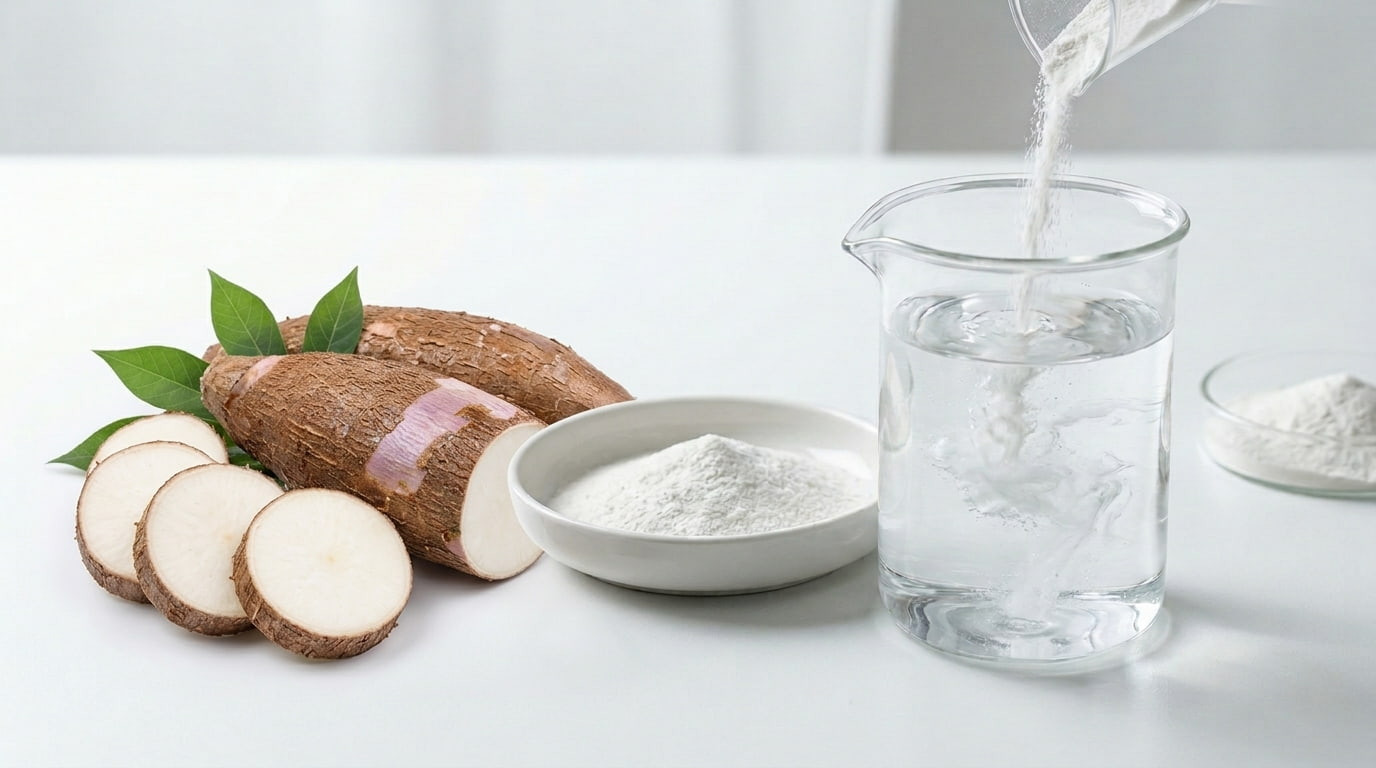
The bigger question that arises is what tapioca is made from. The production of tapioca maltodextrin starts with cassava, a root crop from which tapioca starch is obtained. That starch can then undergo controlled enzymatic hydrolysis that breaks longer starch molecules into shorter carbohydrate chains to produce maltodextrin.
What we get is tapioca maltodextrin, which is generally a fine, neutral-flavored powder. Its neutral sensory profile allows manufacturers to incorporate it into a variation of food items without significantly changing the taste, aroma, or color of a finished formulation.
The processing of the starch is an important factor because it influences the characteristics of the final powder. Depending on the degree of hydrolysis and resulting DE value, manufacturers can select grades suited to different applications and processing requirements.
When manufacturers consider an ingredient, solubility is an important factor for powdered food ingredients. This is specifically critical when a product needs to be reconstituted in water or another liquid.
During the production of tapioca maltodextrin, the breakdown of larger starch molecules into shorter carbohydrate chains contributes to its ability to dissolve in water. This can make it useful in powdered beverages, instant mixes, nutritional formulations, and other products where efficient reconstitution is important.
However, not every maltodextrin behaves in exactly the same way. The degree of hydrolysis, often represented by the DE value, can influence how the ingredient performs.
Dextrose equivalent provides an indication of the level of starch hydrolysis. In general, higher-DE maltodextrins contain a greater proportion of shorter carbohydrate chains and can offer faster dissolution characteristics.
Lower-DE grades, meanwhile, may provide different functional properties that can be valuable in applications where powder structure and processing stability are important.
For product developers, this means choosing tapioca maltodextrin is not simply about selecting a tapioca-derived ingredient. The appropriate grade should be considered alongside the intended application, processing conditions, and desired powder characteristics.
Solubility and dispersibility are closely related, but they are not the same thing.
An ingredient may dissolve readily once it is properly incorporated into a liquid, while its initial ability to spread through the liquid can depend on particle characteristics, moisture content, density, and how the powder is introduced.
The physical structure of tapioca maltodextrin can contribute to its handling and dispersibility characteristics. A well-designed powder can flow more efficiently during manufacturing and mix more consistently with other dry ingredients.
This can be particularly useful in powdered beverage mixes, seasoning systems, nutritional products, and other dry blends where clumping or uneven distribution can create production challenges.
Poor powder flow can lead to problems during weighing, conveying, blending, and filling. Powders that absorb moisture or develop excessive cohesion may become difficult to handle and can form lumps.
For manufacturers, maintaining appropriate storage conditions is therefore just as important as selecting the right ingredient. Packaging, humidity, temperature, and handling practices can all affect powder performance.
Another interesting application of tapioca maltodextrin is its ability to help transform certain liquid or semi-liquid fats into more manageable powdered forms.
When used appropriately, maltodextrin can act as a carrier for fats and other flavor components. This can help create free-flowing powders that are easier to handle, blend, and incorporate into dry formulations.
For example, fat-based ingredients can be combined with maltodextrin at an appropriate ratio to create a powder with improved handling characteristics. When the resulting powder comes into contact with moisture, the carrier can disperse and allow the fat component to become available again.
This functionality can be valuable for product developers working with flavor powders, seasoning systems, beverage mixes, and other applications where liquid fats are difficult to incorporate directly.
When manufacturers select a functional ingredient, they often need to balance technical performance with taste and appearance. An ingredient that exudes a strong flavor, color, or aroma can limit formulation flexibility. This is why manufacturers opt for tapioca maltodextrin for certain food formulations. One of its practical advantages is its relatively neutral sensory profile. It contributes to bulk, texture, carrier functionality, or solids without becoming the dominant sensory characteristic of the finished product.
This makes it easier for product developers to focus on the characteristics they actually want from the formulation, whether that means a particular texture, powder consistency, or reconstitution profile.
Ingredient sourcing is an important consideration for manufacturers developing gluten-free products.
The relationship between maltodextrin and gluten free formulations should be evaluated based on the ingredient's raw material source, manufacturing practices, specifications, and the requirements of the finished product.
Tapioca-derived maltodextrin originates from cassava rather than wheat, making it a useful ingredient to consider when developing formulations that require non-wheat carbohydrate ingredients.
However, manufacturers should always verify supplier documentation and applicable certification or testing requirements rather than making assumptions based solely on the ingredient name.
For companies managing maltodextrin and gluten free requirements, supply-chain transparency can therefore be just as important as the ingredient's functional performance.
Knowing what is tapioca made from provides useful context when comparing different maltodextrin options.
Tapioca is derived from cassava, while other maltodextrins may come from different starch sources. The source can influence how an ingredient fits into a manufacturer's formulation strategy, particularly when considerations such as allergen management, dietary requirements, sourcing preferences, or labeling are involved.
For product developers, the starch source is therefore one part of a larger ingredient-selection decision.
The goal is not simply to find a maltodextrin that works in isolation, but to select an ingredient that performs consistently within the complete formulation and production process.
There are a variety of factors that can affect powder performance. Even a well-suited tapioca maltodextrin grade can perform differently depending on what environment it is used in, and how it is handled.
Manufacturers should consider several variables:
Moisture: Excess humidity can contribute to clumping and affect powder flow.
Storage: Temperature and packaging conditions can influence powder stability.
Mixing: Addition order and mixing intensity can affect uniform distribution.
Particle characteristics: Particle size and structure can influence flow and dispersibility.
DE value: Different grades can provide different solubility and functional characteristics.
Application conditions: A beverage powder may have different requirements from a bakery or seasoning blend.
Manufacturers can achieve more predictable results from tapioca maltodextrin when they take these factors into account.
Selecting the Right Ingredient for Your Application
There is no single powder specification that is ideal for every food application. The right choice depends on what the manufacturer needs to accomplish.
For a beverage application, rapid dissolution and dispersibility may be priorities. Likewise, for a dry blend, flowability and uniform distribution may matter more. In a fat powder, carrier functionality could be the primary consideration.
This is why understanding what tapioca is made from, how the starch is processed, and how the resulting maltodextrin behaves can help product developers make better formulation decisions.
A few factors that manufacturers should consider are supplier consistency, technical support, quality specifications, traceability, and the ability to provide an ingredient suited to the intended processing environment.
Tapioca maltodextrin can offer several useful properties for modern powder-based formulations. What makes it a versatile option for food and beverage manufacturers, is its water solubility, dispersibility, powder-flow characteristics, neutral sensory profile, and carrier functionality.
However, it is essential to understand what tapioca is made from so that manufacturers could put those properties into context, while considering maltodextrin and gluten free requirements can help them make more informed ingredient and sourcing decisions.
Ultimately, the best results come from matching the appropriate maltodextrin grade to the application and then controlling the processing and storage conditions that influence powder performance.
At GluCorp, we work closely with food manufacturers and product developers to find ingredient solutions that fit their specific needs. Our team is here to help if you are a food manufacturer or product developer and are exploring tapioca maltodextrin for a beverage, dry blend, nutritional product, or another application. Get in touch with us to discuss your formulation goals and find an ingredient solution that works for your product and processing requirements.
BackBe the first to know about new products, events and offers.